
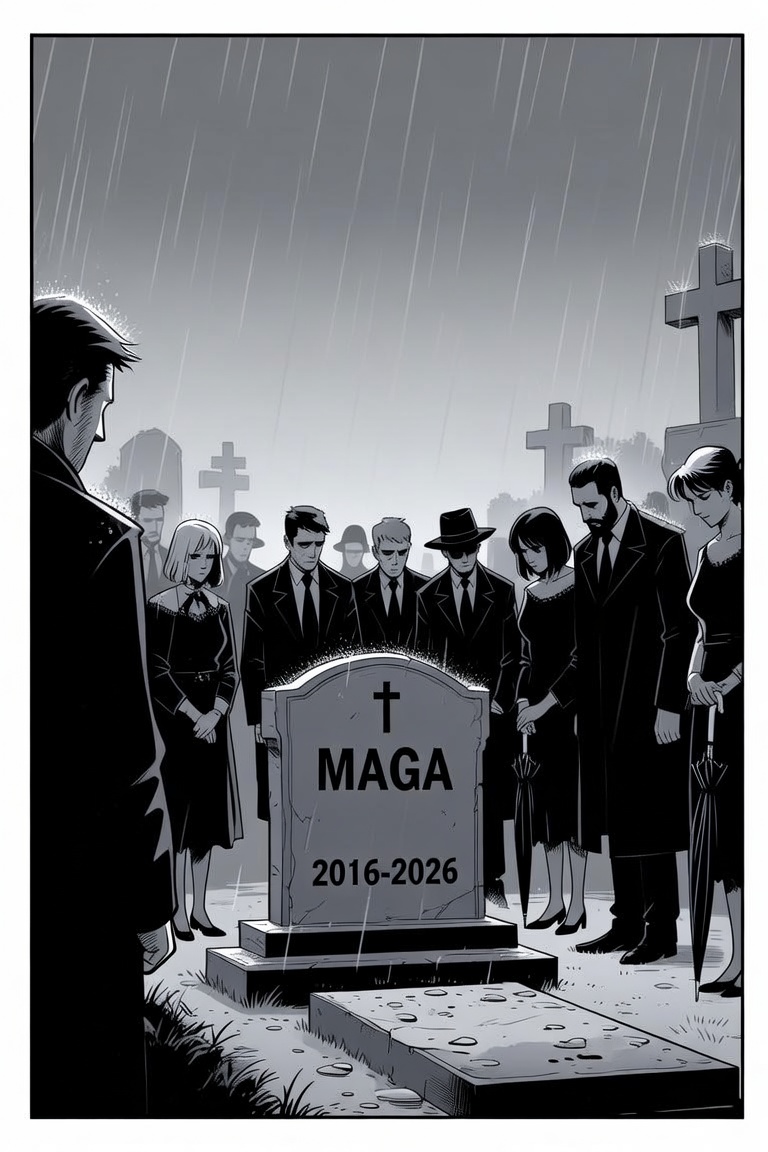
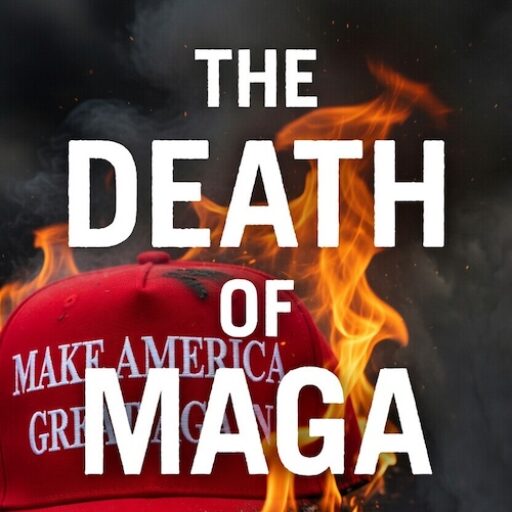
When I officially announced my upcoming book, The Death of MAGA (and Charlie Kirk): An Autopsy on the Populist Conservative Movement that Defined an American Decade, the immediate reaction made it clear why this work was needed. People wanted to know if it was a polemic against Donald Trump, or a defense of him. The partisan instinct is always to flatten complex history into a simple binary: Are you red or blue? Are you for us or against us? Do you support this assassination theory, the next one, or the official version?
I am writing to you not as a partisan operative, but as a conservatarian, independent historian. Yes, I voted for Trump 3 times, but I also voted for Barack Obama in 2008 and Ron Paul in 2012. I was also a delegate for Ron Paul. This book is neither a platform nor a victory lap for the left, or the right. It is an anatomical study—a clinical, unsparing autopsy of the greatest political movement of the last thirty years, how it was captured, and the precise moment its engine was destroyed. For many, that was the exact moment that Charlie Kirk was struck down for the whole world to see on September 10th, 2025.
If we want to understand where American politics goes from here, we must first tell the truth about how we got here.
How We Got Here: From George W. Bush’s Destruction in 2008, the Obama Years, to the Rise of Donald Trump
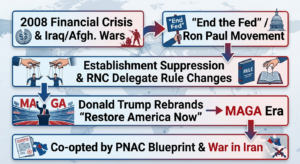
To understand the sudden cooling and collapse of modern conservative Trumpian populism, you have to look past current headlines and trace its actual lineage. The story does not start in 2016; it begins in the economic and geopolitical fallout of 2008’s economic collapse.
The bailouts following the subprime mortgage collapse and the endless bloodshed in Iraq and Afghanistan created a profound populist rupture. On the left, this energy manifested as Occupy Wall Street; on the right, it became the “End the Fed” movement led by Dr. Ron Paul. Both movements were reactions to a bipartisan establishment using central bank liquidity and military power to serve corporate and foreign interests.
In 2012, I served as a Congressional delegate for Ron Paul in Colorado. Across the country, hundreds of thousands of energetic, principled young conservatives rallied around Dr. Paul’s anti-establishment message: audit the Federal Reserve, end foreign interventionism, restore constitutional liberties, and dismantle Washington’s entrenched corruption.
What did the Republican establishment do? They altered the Republican National Committee rules, tightened delegate allocation systems, and forced neoconservative Mitt Romney onto the ballot. Those of us in the room told the establishment crowd plainly: “Enjoy your loss to Barack Obama.”
Following Romney’s predictable defeat, the establishment faced a dilemma. They could not allow a genuine grassroots revolution to dismantle the Federal Reserve or threaten Washington’s military footprint. They needed to harness that explosive energy, pacify the base, and redirect it toward their own geopolitical ends.
Enter Donald Trump. Rebranding “Restore America Now” into “Make America Great Again,” Trump brought an aggressive tone and masterclass marketing to the exact grievances Ron Paul had highlighted. Millions of working-class Americans poured their hope, money, and devotion into this movement. But behind the scenes, “America First” was systematically steered back toward the strategic framework of the neoconservative think tank Project for a New American Century (PNAC). Did Trump do so willingly? Was this his original intention? Those questions, among others, are what we will be reviewing in The Death of MAGA (and Charlie Kirk).
The Project for a New American Century (PNAC) Blueprint, and the Foreign Policy Trap
In their 2000 report Rebuilding America’s Defenses, PNAC outlined a blueprint for permanent American global hegemony, explicitly targeting key nations for regime change: Iraq, Syria, Libya, and Iran. The document explicitly noted that this transformation would be slow, “absent some catastrophic and catalyzing event – like a new Pearl Harbor.”
For two decades, regardless of which administration occupied the White House, that strategic checklist was methodically executed.
| Historical Target | Execution Phase | MAGA Base Alignment |
|---|---|---|
| Iraq | Completed (George W. Bush) | Mass Rejection by Populist Base |
| Libya & Syria | Completed / Destabilized (Obama / Trump) | Widespread Disillusionment |
| Iran | Active Escalation (2025–2026) | Full Structural Fracture |
The turning point for many supporters came with events like January 6th, which served as a primary data point illustrating how a political revolution’s energy could be trapped, neutralized, and weaponized. Instead of dismantling the national security apparatus, the momentum was redirected toward political power, retribution, and the adoption of globalist frameworks like Agenda 2030 and the Great Reset. Jan 6th truly is the embodiment of the methodology and purpose of the Trump administration and its relationship with the American people.
When the administration shifted from domestic economic restoration to an active war with Iran, the movement reached its breaking point. A base that resoundingly rejected foreign nation-building was forced into a profound “Great Re-evaluation.”
Who Was Charlie Kirk: The Transformation and the Sacrifice
At the emotional and structural core of my book stands the life and death of Turning Point USA founder Charlie Kirk and how he truly represented the spirit and the will of the American people.
To understand Charlie, you must look at his political evolution (which arguably mirrored the political identity of the country and this political movement as a whole):
- The Early Years: A young, hyper-energetic organizer building an unprecedented college campus infrastructure for the mainstream Republican Party.
- The Shift: As his influence and financial backing grew, Charlie was centrally aligned with the Republican Party, respecting neoconservative, establishment policies, and was generally supportive of Israel. Likewise, he was also supportive of non-interventionist, libertarian principles of the likes of Ron Paul and Representative Thomas Massie. Charlie Kirk’s internal struggle with these views manifested when he professed he didn’t trust the official narrative of the Oct 7th attack on Israel, or their goal for a Greater Israel resulting with genocide in Gaza.
- The Federal Reserve Stance: Charlie publicly called for Ron Paul to be appointed Chairman of the Federal Reserve to stop the purchasing power erosion impacting working-class Americans.
- The Stance on Iran: Charlie aggressively campaigned against military intervention in Tehran, meeting directly with Trump and publicly warning his millions of followers: “Keep the pressure up. Regime change in Iran would be a catastrophe.”
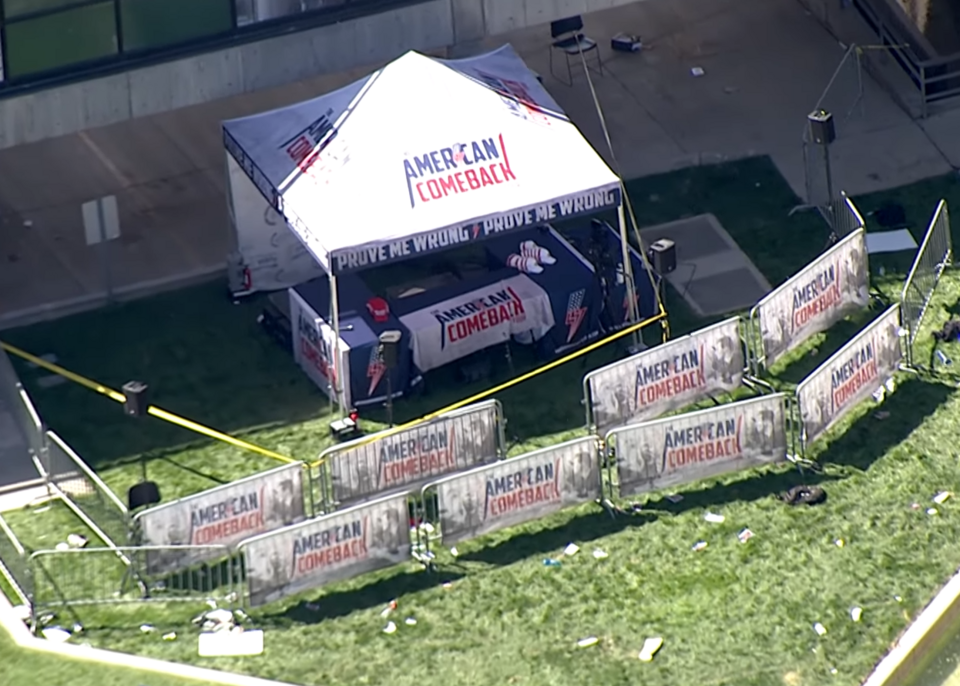
For refusing to align with foreign interests and war hawks, Charlie allegedly faced intense threats of financial ruin for Turning Point USA. On September 10, 2025, he was assassinated in broad daylight—a public execution of a political figure on a scale America had not witnessed since John F. Kennedy. Regardless of how and why he was killed, his voice is no longer here for the first major military intervention since Iraq and Afghanistan.
The Assassination: Forensic Theories, Intelligence, and Social Media
The book dedicates critical chapters to an objective, clinical analysis of September 10, 2025. Rather than indulging in media sensationalism, I break down the specific anomalies and data points surrounding the shooting scene, citing other experts and their analysis. I approach this from an epistemic perspective and do not make any conclusions or allegations, but rather ask obvious questions and document the research done by others. There is simply too much data, and in some circumstances, not enough, to make any conclusions. This is why the comparisons to the JFK assassination are simply too hard to ignore.
- The Digital Intelligence Landscape: How online infiltration, rapid doxing, and social media gossip were deployed immediately after the event to confuse the public and manage the fallout.
- Tactical & Forensic Hypotheses: A detailed critique and summary of the competing theories that emerged from independent investigators and official channels:
- Inconsistencies in the Official Version
- Official Narrative – Support
- Violence from the left
- Known violent leftist networks
- Rise of political violence in America from the left
- The Exploding Mic Theory
- Unmanned Aerial Vehicle (UAV) / Drone Deployment
- The Palmgun Theory
- Evidence of a Second Shooter
- Unanswered questions surrounding Butler and the attempted assassination attempts of Donald Trump
- The Historical Parallel for Multiple Motives: Much like JFK, who challenged foreign nuclear ambitions and rejected a “Pax Americana” military policy before his death, and challenged the power of organized crime, Charlie Kirk stood directly in the path of a neoconservative foreign policy consensus and also was a staunch opponent of the left, and possibly paid for these things with his life.
The Human Element: The Hegelian Dialectic and the Exit Interview
Beyond the high-level intelligence and geopolitical maneuvers, The Death of MAGA centers on the immense human cost paid by everyday Americans.
Through a series of candid accounts—the Exit Interview section, if you will—I document the stories of working-class voters, small-business owners, and young activists who sacrificed family relationships, savings, and personal reputations to support this movement.
By applying the Hegelian Dialectic (“Problem–Reaction–Solution”), the book demonstrates how the genuine anger of the American public was cultivated (Problem), directed into controlled political channels (Reaction), and ultimately leveraged to advance foreign interventions and centralized financial policies that voters explicitly opposed (Solution). The result was the total absolvement and dissolution of the movement’s energy as America and the world prepare to enter a technocratic socioeconomic political future created and facilitated by AI and data centers.
We must have the courage to ask hard questions and demand answers supported by truth. We cannot rebuild a free republic until we understand how this populist movement was derailed, who benefited from its collapse, and what was lost along the way.
That is why I wrote this book. It is time for a complete accounting.
Joseph Pendleton